
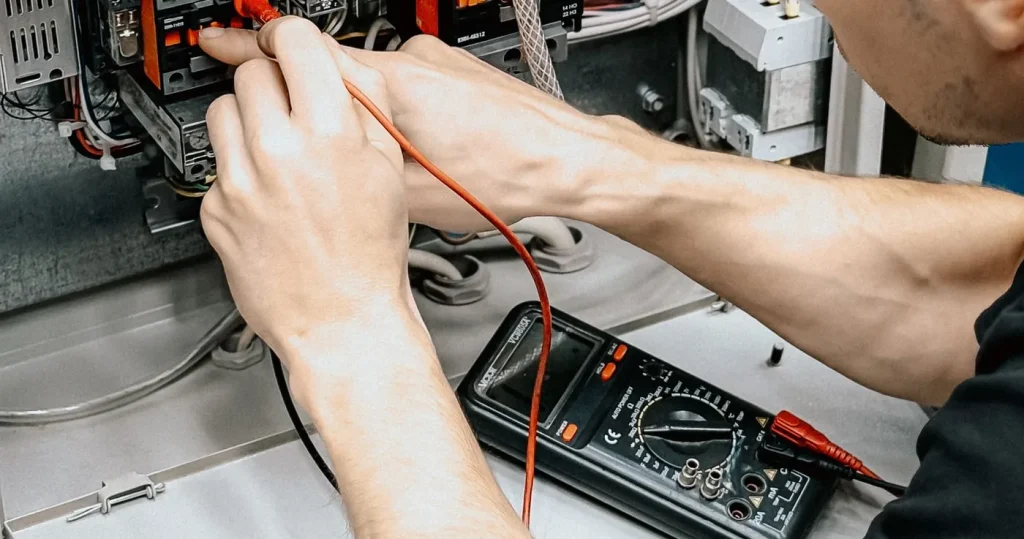
So how much does an electrician cost in Singapore? For most common household jobs, expect S$60–S$220 per item once you include the call-out, with bigger jobs like distribution board replacement starting around S$250 and a full HDB rewire running S$2,000–S$7,000. Those are the honest market bands — but the per-item price is only half the story. What actually decides your bill is how the electrician charges, what is bundled into the number, and whether the job legally needs a licensed electrical worker to sign off. This guide breaks down all three, using rates Singapore firms actually publish in 2026.
The short answer: typical price bands in 2026
Here is what published price lists from Singapore electrician firms look like this year. Every firm structures its list differently, so treat these as bands, not quotes:
| Job | Typical 2026 band | Notes |
|---|---|---|
| Transport / call-out fee | S$40–S$80 | Often waived if you proceed with the job |
| Install new power socket | From S$50 | Surface wiring; concealed costs more |
| Replace existing socket | S$60–S$120 | Like-for-like swap is the cheap end |
| New light point | S$80–S$180 | Per point; excludes the light itself |
| Install / replace light fitting | From S$120 | Additional items usually cheaper each |
| Ceiling fan installation | S$80–S$220 | Heavier fans and false ceilings cost more |
| Replace distribution board (DB) | From S$250 | Price rises with circuit count |
| Full HDB flat rewiring | S$2,000–S$7,000 | Depends on flat size and concealment |
These bands line up with what the firms ranking on page one for this exact question publish — one lists light fittings from S$120, another lists sockets from S$50 with a S$40 transport fee, and a third quotes socket replacement at S$60–S$120 and ceiling fans at S$80–S$220. When a quote sits far outside these ranges in either direction, ask why.
Per-job pricing vs hourly rates
Most Singapore electricians price per job, not per hour — the table above is how you will actually be quoted. Hourly billing exists mainly for commercial work, long troubleshooting sessions and some emergency callouts. When electricians here do bill by time, the effective rate typically works out to roughly S$70–S$150 per hour once the call-out is folded in, with troubleshooting often quoted as a flat “diagnostic” fee that converts into the repair price if you proceed. If someone quotes you a bare hourly rate with no scope, pin down what happens if the job runs long — that is where hourly arrangements get expensive.
What actually decides the price
Two identical-sounding jobs can be priced S$80 and S$250 for legitimate reasons. The main multipliers:
- Concealed vs exposed wiring. Running a new point through trunking on the wall surface is quick. Chasing the same cable into the wall, then patching and making good, can double or triple the price.
- Access. High ceilings, false ceilings, and furniture-blocked walls all add time.
- Materials. A quality socket or isolator costs more than the cheapest fitting on the shelf; check whether parts are included in the quoted number.
- Urgency. Same-day and after-hours work carries a premium (more below).
- Testing and certification. Work that affects your DB or consumer unit should end with proper testing — that time is part of an honest quote.
Emergency and after-hours pricing
A 24 hour electrician exists for the night your whole flat trips and will not reset. Expect the call-out for an emergency electrician in Singapore to run noticeably higher than daytime rates — often 1.5–2× — because you are paying for availability, not just labour. Two ways to keep this cost down: first, learn where your main switch and circuit breakers are before an emergency, because many “emergencies” are a single tripped RCCB you can isolate yourself; second, if power is partially working, waiting until morning usually halves the bill.
Rewiring: the big-ticket job
Complete rewiring is the job where quotes vary most. The realistic 2026 band for an HDB flat is S$2,000–S$7,000 — a 3-room flat with straightforward runs sits at the lower half, a 5-room flat with full concealment, new trunking routes and a new DB lands at the top. What moves the number: flat size, how many points you add while the walls are open, whether wiring is concealed or surface-run, and the state of the existing conduits. Rewiring almost always makes sense to do during renovation rather than after — the hacking, patching and painting are already happening, so you pay for the electrical work only once.
The hidden costs cheap quotes leave out
The lowest number on WhatsApp is rarely the lowest final bill. Before comparing quotes, check whether each one includes:
- Transport / call-out — some firms add it back at the end.
- GST — quoted with or without?
- Materials — “labour only” quotes can grow 30–50% once parts appear.
- Making good — who patches and paints the wall after concealed work?
- Disposal — old DBs, fittings and cable have to go somewhere.
- Testing — a proper handover includes checking the circuit, not just “it turns on”.
A complete quote that looks 20% dearer is often the cheaper job once these lines are added to the “cheap” one.
When the law requires a licensed electrical worker
Singapore regulates electrical work through EMA’s Licensed Electrical Worker (LEW) scheme, which covers three classes — licensed electrician, licensed electrical technician and licensed electrical engineer. Electrical installation work is required to be carried out by or under the supervision of an LEW; that is also who signs off work involving your DB or new circuits. A licensed electrician singapore homeowners engage through a proper firm will carry this licence — ask for the licence number, and be suspicious of anyone offering DB work at a price that makes no room for a licensed signature. We cover exactly which jobs need an LEW in our guide to whether you need a licensed electrician in Singapore.
HDB flats: the two extra questions
For HDB owners there are two wrinkles worth knowing before you get quotes. First, if your flat still runs on the original 30-amp loading, installing new 15-amp power points (the kind aircon systems need) requires an HDB permit — an experienced hdb electrician will flag this before quoting, not after. Second, if your renovation plans include multiple aircon units, a water heater and an induction hob, ask about upgrading the flat’s electrical loading at the same time; doing it with other electrical work is far cheaper than a separate visit. Smart switches are a related trap: most HDB switch boxes have no neutral wire, which changes what can be installed — see our guide to smart switches and HDB wiring.
How to pay less (without paying twice)
- Bundle jobs into one visit. The call-out and setup time are fixed; the second and third items in the same visit are usually charged at a lower per-item rate.
- Do electrical work during renovation. Walls open, protection down, painter already booked — every concealed job is cheaper now than later.
- Plan points properly once. The most expensive socket is the one you add twelve months after the reno. If you are wiring anyway, plan for the smart home you might want — extra points at the TV console, router location and curtain pelmets cost little during the reno and a lot after.
- Get the price list in writing. Firms with a published electrician singapore price list are easier to hold to their numbers than a verbal estimate.
Frequently asked questions
How much do electricians charge in Singapore?
Most common jobs fall between S$60 and S$220 per item — socket replacement S$60–S$120, new light points S$80–S$180, ceiling fan installation S$80–S$220 — plus a transport fee of around S$40–S$80 if you do not proceed. Distribution board replacement starts around S$250 and full flat rewiring runs S$2,000–S$7,000.
How much should you pay for an electrician?
Judge the quote, not just the number: it should state the scope, include materials or say they are excluded, name the transport fee and GST treatment, and make room for testing. A quote within the market bands above, in writing, from a firm that can name its LEW, is one worth paying.
What is the average hourly rate for electricians in Singapore?
Most residential work is priced per job rather than per hour. Where time-based billing is used, the effective rate typically works out to roughly S$70–S$150 per hour including the call-out, with after-hours emergency work higher.
How much does it cost to rewire a 3-room flat?
A 3-room HDB rewire generally sits in the lower half of the S$2,000–S$7,000 rewiring band — commonly S$2,000–S$4,000 depending on concealment, the number of points, and the state of existing conduits. Doing it during renovation is significantly cheaper than as a standalone job.
Do electricians charge for quotations or transport?
Many firms charge a transport / call-out fee of around S$40–S$80, and commonly waive or absorb it if you proceed with the work. Always ask upfront — it is the most frequently “forgotten” line in a verbal quote.
Is it cheaper to do electrical work during renovation?
Almost always. Concealed wiring, new points, loading upgrades and DB work all share costs with the renovation (hacking, making good, painting) that you would otherwise pay for on their own. The savings on a multi-point job routinely exceed the price of several individual visits.
Want a straight price, not a mystery number?
Roen’s electricians handle sockets, lighting, ceiling fans, DB upgrades and full rewiring across Singapore — quoted clearly before work starts, and planned so your wiring is ready for the smart home you might add later.
Price bands reflect rates published by Singapore electrician firms as at 2026 and are indicative only; your quote depends on site conditions, materials and scope. Electrical installation work in Singapore is regulated under EMA’s Licensed Electrical Worker scheme — use licensed professionals for works that require one.