
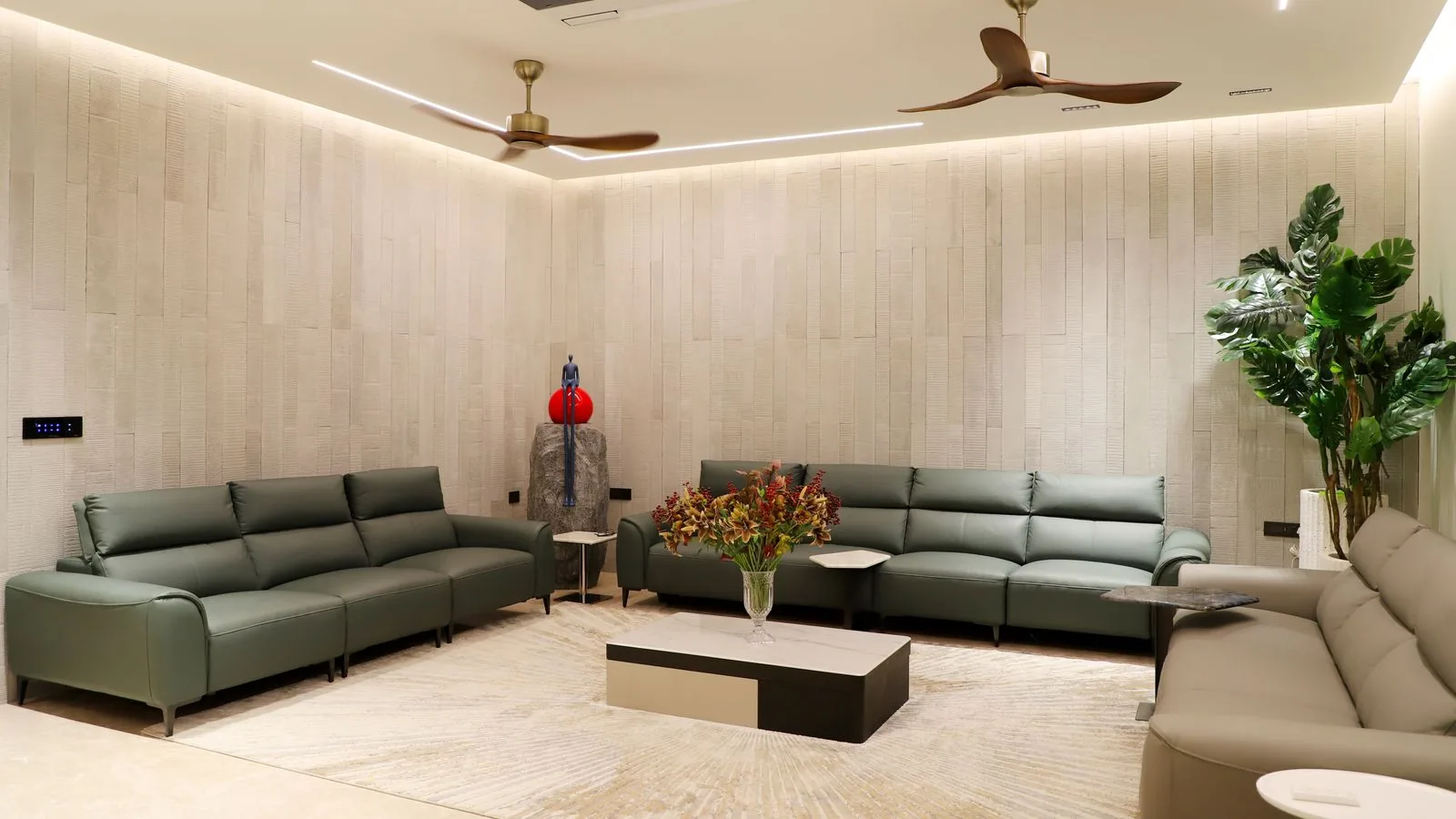
Roen fits, wires and connects smart ceiling fans across Singapore, and most of the time we keep the fan already on your ceiling and make it answer your phone, your schedule and your voice. We are installers, not a fan shop, so we will tell you when a controller beats a new fan, and we talk about the speed you will actually live at rather than the one on the box.
Most Singapore homes end up with a fan on a pull cord, a remote that lives under the sofa, and a wall plate nobody trusts. Roen does the mount, the wiring, the controller and the app in one visit, so the fan behaves like part of the house rather than another gadget.
If the fan on your ceiling still runs well, we usually keep it. A smart fan controller or a smart wall switch puts speed, and often the light, on your phone without a new fixture. A shop has no reason to tell you this. It is the first thing we check.
Fan points, the fan controller, no-neutral situations in older HDB flats and the back-box depth are all part of the same job. Heavier electrical work goes to our own licensed team.
The complaint we are called out for is never top speed, it is the hum at the bottom. That is why the bench below shows a noise figure at every speed, and why the lowest usable speed decides every bedroom fan we specify.
The fan lands on the same hub as your aircon, lights and curtains, so a single scene can drop the aircon a degree and lift the fan a speed instead of freezing the room.
The Singapore reason to put the fan on the app: a fan moving air lets the aircon sit a degree or two higher for the same comfort. That only happens reliably when one system runs both, which is the whole point of connecting the fan to your smart home hub rather than leaving it on its own remote.
Not a catalogue. These are the fan situations that come up again and again in HDB flats, condos and landed homes here, and what connecting each one involves.
Six speeds, reversible, and markedly quieter at low speed. A smart DC ceiling fan Singapore bedrooms can actually sleep under, and the default choice upstairs.
Three speeds and a simpler motor. Usually retrofitted with a smart wall switch or an inline controller.
One fixture, two circuits. Fan speed and light brightness end up as separate controls in the app.
Low-speed noise is the whole decision here. Sleep schedules and a gentle ramp-down matter more than top speed.
Big sweep, sometimes two fans on one scene so the whole space moves together instead of fighting.
Weather-rated fans for balconies, patios and PES areas, with the control kept indoors and dry.
The cheapest route to app control when the fan is fine and only the switch is dumb.
Goodnight, Movie, Away. The fan changes speed with everything else rather than being set by hand.
Switch the motor between DC and AC, move the speed, turn the light on and change the room. The fan, the light, the power draw, the noise and the recommended sweep all react together, which is the actual difference between a smart DC ceiling fan and the AC fan most flats already have.
Power and noise are indicative typical ranges for DC and AC ceiling fan motors, shown to illustrate the difference between the two. The figures for a specific model come from that model.

That is the honest case for a smart DC ceiling fan in a Singapore bedroom: not the top speed, but the bottom one. A DC motor will sit at a speed an AC motor cannot hold steadily, draw a fraction of the power overnight, and reverse in the dry months. On a living room fan that runs on speed four all evening, the difference matters far less, and keeping a good AC fan and adding a smart wall switch is usually the better value.
A smart ceiling fan with light is really two devices sharing a mount. Done properly the fan speed and the light brightness arrive in your app as separate controls, so “dim the light” does not slow the fan and “fan up” does not brighten the room.
If the light kit matters more than the fan, look at smart lighting for the rest of the room at the same time. Doing both in one visit avoids a second ceiling job.

We do not sell fans and we do not rank brands, so this is a comparison of the two decisions that actually change how a fan lives in a Singapore flat. Use it the way our installers do. Anyone searching for the best smart ceiling fan Singapore sells will find a dozen product listicles; what they rarely find is an installer saying which of these rows should decide it in their own flat.
| What you are comparing | Smart DC ceiling fan | Smart AC ceiling fan | Why it matters here |
|---|---|---|---|
| Speed steps | Typically 6, often with a very low first speed | Typically 3 | The lowest usable speed decides whether a bedroom fan is liveable overnight. |
| Power draw | Substantially lower, especially at low speed | Higher across the range | Matters most on a fan that runs eight hours a night, every night. |
| Noise at low speed | Quieter | Audible hum is common | The single most frequent complaint we are called out to fix. |
| Reverse / winter mode | Usually yes | Usually not | Less useful in Singapore than in temperate markets. Be honest with yourself about this one. |
| Upfront cost | Higher | Lower | An AC fan plus a smart switch is often the better value in a living room. |
| Airflow | Not automatically higher | Not automatically lower | Air movement comes from blade design, pitch and sweep far more than from the motor. A good AC fan will out-move a poor DC one. |
| What goes wrong | An electronic driver that fails as a module, and proprietary remotes and receivers | Simpler, and parts are easier to source years later | The honest cost of DC. Nine retailer pages will not tell you this one. |
| Retrofitting what you own | Usually needs the fan replaced | Often just a controller or a smart switch | If your existing fan is quiet and in good order, this row usually decides it. |
General characteristics of DC and AC ceiling fan motors. Individual models vary, which is why we look at the model rather than the motor type on its own.

Buy for the lowest speed and the noise floor, not the top speed. You will live at speed one and two.

A bigger blade span moving slowly beats a small fan working hard, and two fans on one scene beat one fan on maximum.

Outdoor and semi-outdoor areas need a weather-rated fan. The controller stays indoors and dry.
Sizing is the part a fan shop answers with a filter and an installer answers by looking at your ceiling. Three numbers decide it: the blade sweep against the room, the finished ceiling height, and how far the blades end up above the floor.
| Room | Usual sweep | Mount | What actually decides it |
|---|---|---|---|
| HDB or condo bedroom | 42 to 46 inch | Short downrod, or a hugger under about 2.6 m | The lowest usable speed and the noise floor. You will live at speed one and two, not at six. |
| Living or dining | 52 to 56 inch | Downrod, centred over the seating | Where people sit, not the centre of the room. A fan centred on a light point is often centred on nothing. |
| Large living-dining | 60 to 70 inch, or two fans | Downrod | A big sweep turning slowly beats a small fan working hard. Two fans on one scene beat one fan on maximum. |
| Balcony, PES or semi-outdoor | 48 to 56 inch | Weather-rated fan, controller kept indoors | The rating comes before the size. Sheltered is not the same as rated. |
| Low or dropped ceiling | 42 to 52 inch | Hugger, also sold as flush or low-profile | Blade clearance above the floor. Once a false ceiling has eaten the headroom, the hugger is the safe call regardless of room size. |
The number nobody quotes you. Sweep is chosen for the room, but the mount is chosen for the height. We measure the finished ceiling, not the slab, because a false ceiling, a cove or a bulkhead can take 150 to 300 mm out of the room before the fan is even ordered. That is also why a fan that fitted your last flat may be wrong in this one.
Roen does not carry one fan brand, so the recommendation changes with the room rather than with what we happen to stock. Where a fan has its own app, we still bring it onto the same hub as everything else.
 KDK
KDK
 Crestar
 Fanco
Fanco
 Elmark
 Panasonic
 Efenz
Efenz
 Google Home
 Apple Home
 Alexa
Alexa
 Home Assistant
 Tuya
Tuya
 Aqara
Aqara
Related, not identical. KDK sits within the Panasonic group and you will see both names in the fan aisle here. On site they behave as two ranges, with their own mounts, controllers and remotes.
Sold and supported locally, and one of the names we most often find already on a ceiling here, along with KDK, Crestar and Elmark. We are not a dealer for any of them.
No winner from us. Both run ranges from good to ordinary. Judge the model, not the badge: lowest usable speed, sweep against your room, and whether the remote and receiver are a standard part or one you will chase in five years.
One practical warning. Some fan remotes pair on 2.4 GHz only, and a mesh network that merges 2.4 and 5 GHz under one name will fail the pairing step without telling you why. That is a home network problem, not a fan problem, and it is worth knowing before you blame the fan.
This is the most asked question on this search and almost nobody who answers it is an installer. Below is what the Singapore market currently publishes for the labour, taken from rate cards that are live today and named underneath. These are market rates, not Roen's. The number that applies to you is decided by your ceiling, which is why we quote after we have seen it.
| The job | Published market rate | What actually moves the number |
|---|---|---|
| Straight swap, concrete ceiling, existing fan point and switch | $40 to $90 per fan | Ceiling height, almost entirely. One rate card bands it $40 at 2.7 m and below, $50 to 2.99 m, $60 to 3.19 m, $80 to 3.39 m. A manufacturer's own technicians list $60. A retailer sells it as a fixed $90 line item. |
| False ceiling, reusing the existing support | $60 to $80 per fan | Only if the electrician judges the old support sound. Plenty are not. |
| False ceiling, building a new support | $150 to $200 per fan | Plasterboard carries nothing. The support has to be taken back to the slab in metal or timber. |
| Mounting on a centre panel | $80 to $140 per fan | Long rod usually charged separately. |
| No fan point at all, making a new one | $80 to $200 per point | Surface PVC casing is the cheap end. This is licensed electrical work, not fan work. |
| The bad case: false ceiling, new support and a new point | up to $440 per fan | Published as the top of one manufacturer-technician rate card. Worth knowing it exists before you are surprised by it. |
| Bypassing an old regulator, or adding a switch | $10 to $22 | Old wall regulators and dimmers should come out of a smart fan circuit, not stay in it. |
| Extending wiring | $30 per metre surface, $150 per metre concealed | Concealed means chasing the wall and making good afterwards. |
| Taking the old fan away | $5 to $20 | Charged per fan or per trip depending on who does it. |
| The smart layer: controller, smart switch, hub and scenes | Quoted with the job | None of the rate cards above price this, because none of them do it. It is the part that turns a fan into a smart fan, and the part we do. |
Singapore market rates for labour, read from published rate cards, September 2026. Your ceiling height, your ceiling type and whether a fan point already exists decide where in each range you land.
Why we publish somebody else's prices. Because the honest answer to what a fan costs to install is a range, and because the three numbers that decide where you land in it are your ceiling height, your ceiling type and whether a fan point already exists. A shop quotes you before it knows any of them. We would rather you walked into the consult already knowing what the market charges, and already knowing which questions we are going to ask about your ceiling.
The same sequence whether we are hanging a new DC fan or making the one you own smart.
We look at the ceiling, the existing point, the switch plate and the room size, and tell you whether a retrofit will do.
Sweep size, mount height, DC or AC, and whether the light kit needs its own circuit.
Bracket, downrod, balancing, and the controller or smart switch wired in. Anything heavier goes to our licensed team.
The fan joins your hub, gets into the scenes that already exist, and answers Google or Apple by name.
We show you the app, the wall plate and what happens when the WiFi drops, then leave the room tidy.

A fan that wobbles at speed five was mounted badly, not bought badly. Four conditions cover almost every Singapore ceiling: a concrete slab with an existing rated fan point, the easy one; a false ceiling, which needs a support brought back to the slab because plasterboard carries nothing; a centre panel or cove, where the fan has to be set off-centre or the panel opened; and no fan point at all, which turns the job electrical. We tell you which one you have at the consult.

Guests, helpers and children should not need an app. The physical control keeps working exactly as before.

Within a fortnight most people run the fan by schedule, scene or voice and barely open the app at all.
Plenty of fan jobs are a bracket and a controller. Some are not. If there is no fan point, if the box is not rated for the weight, if the switch has no neutral, or if the circuit needs work at the board, it stops being a smart home job and becomes an electrical one.
Roen has that team in house, so it is still one contractor and one invoice. If what you actually need is straightforward ceiling fan installation singapore without the app layer, start there instead and we will tell you honestly if the smart part is worth adding.

The mount, the wiring, the controller and the app are one job with one contractor, not three trades blaming each other.
If the fan you own is quiet and well mounted, a controller is the answer. We say so even though it is the smaller job.
No-neutral HDB plates, back-box depth, 2.4 GHz pairing behind a merged mesh, balcony ratings. Overseas pages cannot write this.
Fans stay usable when the internet drops. The wall plate and local scenes keep working regardless.
These are the questions Google shows on these searches, in Google's own words, answered by the people who fit the fans rather than the people who sell them.
Usually yes, and this is the answer a fan shop has no reason to give you. If the motor is sound and the fan is quietly mounted, a smart fan controller tucked into the canopy, or a smart wall switch at the plate, puts speed and often the light on your phone. We only recommend replacing the fan when the motor is noisy, the mount is unsound, or you specifically want DC speeds and reverse.
The same answer, with the practical limit: it depends on what is behind your wall plate, not on the fan's age. Older HDB switch positions often have no neutral wire, which rules out some smart switches and points you at a canopy controller instead. We check that at the consult before quoting, not after.
Four steps. We check the canopy space, the wall plate and whether there is a neutral. We fit either an in-canopy controller or a smart wall switch. We pair it to your hub and name it sensibly. Then we put it into the scenes and schedules you already have, so it runs without you.
It puts speed, direction and, where there is a light kit, brightness onto your phone and your voice, and it lets the fan take part in automations. That is the real difference: a schedule can drop it to speed one at bedtime, a sensor can switch it off when the balcony door opens, and one Goodnight scene can set the fan and the aircon together instead of you doing both.
In a Singapore bedroom, usually. You are buying the bottom of the range, not the top: a genuinely low first speed and a much smaller overnight draw. In a living room running at a middling speed all evening, a good AC fan plus a smart switch is often better value. Reverse mode is a real DC feature that matters far less in this climate than the marketing suggests.
Worth knowing before you spend. A DC fan runs through an electronic driver, so there is a component that can fail on its own and it is usually a whole-module replacement rather than a repair. Remotes and receivers tend to be proprietary, so a lost remote can mean a matched part rather than a generic one. Upfront cost is higher. And some cheaper DC units still hum at the top speed, which defeats the reason people buy them.
Not automatically. Airflow comes from blade design, pitch and sweep far more than from the motor type, and a well-designed AC fan can move more air than a poor DC one. What the DC motor reliably gives you is more usable steps, a quieter low end and a lower draw for the same airflow. If raw air movement is the goal, look at the sweep first.
Ask where the fan lives. Bedroom, or anywhere you sleep or work quietly: DC, for the low speed and the noise floor. Living or dining that runs at a middling speed all evening: either, and an AC fan plus a smart switch is often the better spend. Balcony or semi-outdoor: the weather rating decides it before the motor does.
A hugger, also sold as a flush or low-profile mount, which sits close to the slab instead of hanging on a downrod. Most HDB flats have enough height for a short downrod, but once the finished ceiling drops below roughly 2.6 m, or a false ceiling eats the headroom, a hugger is the safe call. Blade clearance from the floor is the number that matters, not the fan's badge.
Not for every job. Swapping a fan on an existing, properly rated fan point is ordinary installation work. Adding a new point, altering a circuit or working at the DB board is licensed electrical work in Singapore, and Roen handles that with its own team. See ceiling fan installation singapore for the electrical side.
On an existing, correctly rated fan point some people do. The two things that go wrong are weight and wobble: a ceiling box rated for a light fitting is not rated for a fan's weight and vibration, and an unbalanced mount is the noise people later blame on the motor. Anything that touches a circuit or the board is licensed work and is not a DIY job here.
A straight swap on an existing, rated point is the short end of the range and a single visit; a new fan point, a false-ceiling support or a switch change adds materially to it. We give you the expected duration at the consult rather than on a web page, because it is the ceiling that decides it.
Published Singapore market rates for the labour run from about $40 to $90 for a straight swap on an existing concrete-ceiling fan point, and the figure is driven mostly by ceiling height. A false ceiling that needs a new support takes it to roughly $150 to $200, a centre panel to $80 to $140, and a job with no existing point at all can reach $440. Those are third-party rates read from live rate cards on 22 September 2026, not Roen's. The full breakdown, with sources, is in the rate table above.
Budget for the ceiling, not the fan. Ask three questions before you accept any quote: how high is the finished ceiling, is it concrete or false, and is there already a fan point with its own switch. Those three answers move the labour by a factor of ten across the published market range, and any quote given without them is a guess.
They are related, not identical. KDK is a long-standing fan brand that sits within the Panasonic group, and in Singapore you will see both names in the fan aisle. From an installation point of view they behave like two separate ranges with their own mounts, controllers and remotes, so we treat them as such.
Fanco is sold and supported locally in Singapore and is one of the names we most often find already on a ceiling here, alongside KDK, Crestar and Elmark. We are not a dealer for any of them, so when we say a fan is worth keeping it is not because we sell that badge.
We will not give you a winner, because the honest answer from an installer is that both put out ranges that go from good to ordinary. What we can tell you is what we see on service calls: judge the specific model by its lowest usable speed, its blade sweep against your room, and whether the remote and receiver are a standard part or a proprietary one you will struggle to replace in five years. Those three decide how the fan lives with you.
The common complaints are a dry throat, dry eyes and a stiff neck or shoulder from air blowing straight onto you for hours, and dust being moved around a closed room. None of that is a reason to avoid a fan; it is a reason to run it low and not aim it at the bed. This is one of the better arguments for a DC fan and a schedule: a genuinely low first speed, and an automation that eases the fan down after an hour instead of leaving it on four all night.
In this climate, generally yes, and the reason is the aircon rather than the fan. Moving air makes a given temperature feel cooler, so many households find they sit a degree or two higher with the fan running. We will not put a savings figure on that, because it depends on your unit, your room and your habits. Running both from one system is what makes the trade-off automatic instead of something you remember to do.
A well-mounted fan outlasts most of the electronics in the house, which is exactly why our first answer is usually a controller rather than a new fan. What tends to fail first is not the motor but the remote, the receiver or, on a DC unit, the driver, and those are replaceable. A fan that has become noisy is more often a mounting or bearing problem than a fan that has reached the end of its life.
We have deliberately not answered what is the best smart ceiling fan in Singapore with a ranked product list. We do not sell fans, we have no affiliate arrangement with any brand, and a list from an installer who has not tested them is worth nothing. What we can do is tell you which of the fans already in Singapore homes we are called back to fix, and why.
Tell us the room, the ceiling height and your timeline. We will reply with a recommendation and a quote.
Tell us the room and what is on the ceiling now. We will say whether a controller will do it, or whether the fan is worth changing, before anyone quotes you for anything.
hello@roen.com.sg · 80 Playfair Road, Singapore 367998