
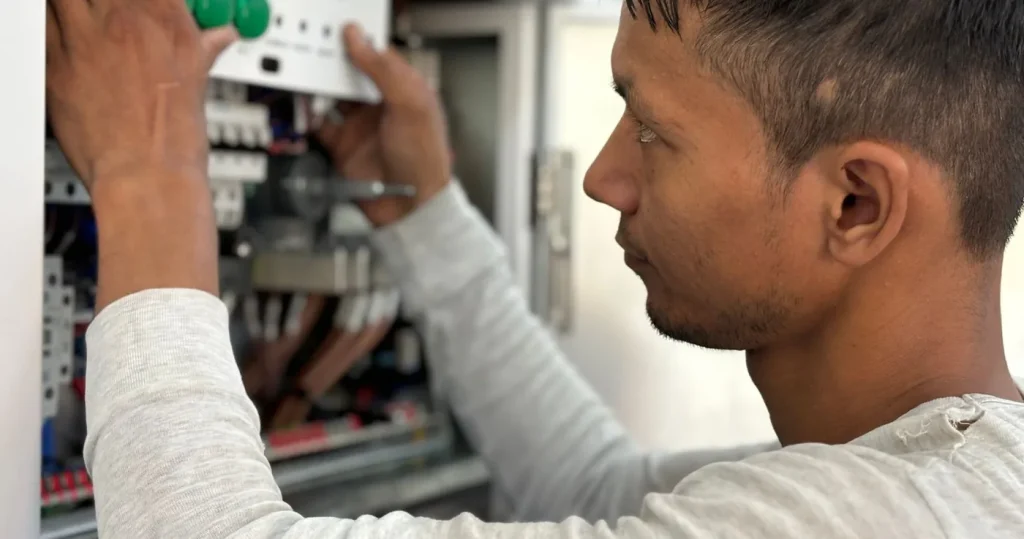
If the power keeps tripping in your flat, one of three things is happening: a circuit is carrying more current than its breaker allows, an appliance or a cable is leaking current to earth, or the fault is outside your unit altogether. The first two are yours to narrow down and a licensed electrical worker’s to fix; the third is SP Group’s. Below: how to tell which you have from the distribution board (DB), what you can safely check yourself, which of three numbers to call, and why last year’s smart-home kit is a trip cause the electrician blogs never mention.
Why the power keeps tripping: read the DB box first
Open the DB box and look at which switch has dropped, because the two kinds of protective switch trip for different reasons. The miniature circuit breakers (MCBs) are the row of small switches, one per circuit: lights, sockets, aircon, water heater, cooker. An MCB trips when its circuit draws too much current, an overload or a short circuit. The residual current circuit breaker (RCCB, older boards say ELCB) is the wider switch with a “Test” button. It does not care how much current flows; it compares what goes out on live with what comes back on neutral, and if the difference reaches 30 milliamps it cuts everything. EMA requires every residential premises to have an RCCB or ELCB rated at 30 mA or lower; the rule became enforceable on 1 July 2025 with a fine of up to S$5,000, and HDB flats built before 1985 did not come with one. When the power keeps tripping, the switch that dropped is the first clue.
| Which switch dropped | What it means | Usual cause in a Singapore home | Who fixes it |
|---|---|---|---|
| One MCB only | Overload or short on that circuit | Kettle, air fryer and rice cooker on one kitchen ring; aircon start on a tired breaker; a failed appliance | You, by spreading the load; a LEW if it trips with nothing plugged in |
| RCCB (the one with the Test button) | Earth leakage of 30 mA or more, anywhere in the flat | Water heater, washing machine, fridge or aircon with ageing insulation; a wet socket; a nail through a cable | You, by unplugging to isolate; a LEW to repair |
| Main switch or isolator | Whole-flat overload or a fault in the board | Demand above the rating of the flat’s main switch | A LEW, possibly a supply upgrade |
| Nothing dropped, block dark | Supply interruption outside your unit | Riser, substation or network fault | SP Group, 1800 778 8888 |
Power trip Singapore homes see most: the five causes
After enough call-outs the causes sort into five groups, and a good electrician Singapore homeowners call for a recurring trip will test for them in roughly this order.
- Overload on one circuit. The classic HDB kitchen: induction hob, kettle, air fryer and microwave on the same 13 A ring. The MCB drops, nothing is damaged, and it holds once you spread the load. HardwareZone has a whole thread on kitchen-appliance trips, and the answer is a dedicated circuit for the hob, not a bigger breaker.
- A leaking appliance. EMA’s Inspectorate Department says that when a newly renovated, already inspected flat keeps tripping, the fault usually lies with a faulty appliance rather than the wiring. Washing machines and old fridges are the usual suspects.
- The water heater. A storage heater’s element leaks a little more each year until the RCCB notices; an instant heater on an undersized circuit trips the MCB instead. EMA warns that a water heater must never be plugged into a standard three-pin socket, and that a LEW must install a dedicated connection point if the home lacks one.
- Aircon. A compressor start draws a surge well above running current. On a shared circuit or a tired breaker the surge trips it, more often in hot weather. A damp outdoor unit, or water tracking into the fan coil wiring, trips the RCCB instead.
- Wiring and moisture. A cable nicked by a renovation drill, a junction box in a wet kitchen wall, a socket behind a leaking basin. These trip the RCCB with everything unplugged, and you cannot fix them yourself.
What to check yourself before you call anyone
The safe boundary stops at the cover of the DB box. You may operate the switches. You may not open the board, replace a breaker or touch a terminal: EMA’s guidance is that repair or replacement of consumer control units or circuit breakers should be carried out or supervised by a Licensed Electrical Worker, and buying a breaker online to swap yourself is exactly the DIY it warns against. Within that boundary, this sequence finds why the power keeps tripping in most flats:
- Note which switch dropped (see the table) and photograph the board for the electrician.
- Switch every MCB off, then switch the RCCB or main switch back on. If it holds, the board and supply are fine and the problem is on one circuit.
- Switch the MCBs back on one at a time. The one that drops the RCCB is the faulty circuit.
- On that circuit, unplug every appliance, reset, then plug them back one by one. The one that trips it is your answer. Water heater and aircon have their own isolators; test them the same way.
- If the RCCB drops with every MCB off, or with that circuit’s appliances all unplugged, stop. That is a wiring fault or a failed breaker and it needs a LEW.
Two things end the checklist early. A burning smell, scorch marks, sparking or water near the board means switch off at the main and keep clear until someone qualified arrives. And if you cannot find an RCCB at all, make that call first; a board without one is no longer legal.
Who to call: SP Group, a LEW or HDB
Most guides give one or two of these numbers. Here are all three, with the situation each is for.
| Situation | Call | Number or link | Source |
|---|---|---|---|
| The block or corridor is dark, or your flat is dark and nothing in your DB has dropped | SP Group Electricity Service Centre, 24-hour hotline for supply interruption | 1800 778 8888 | spgroup.com.sg/contact-us |
| Only your flat trips, and the RCCB or an MCB will not hold or trips with everything unplugged | A Licensed Electrical Worker (LEW): check the name on EMA’s ELISE register and ask to see the licence card | elise.ema.gov.sg | ema.gov.sg, Engaging Licensed Workers |
| HDB flat, and you cannot find an RCCB in the DB box | HDB Branch Service Line | 1800-225-5432 | ema.gov.sg RCCB FAQ |
For what a LEW may sign off that a handyman may not, our guide on whether you need a licensed electrician (LEW) covers it.
Why the power keeps tripping at night, in hot weather or during a storm
Three patterns come up in almost every enquiry. At night: the water heater or the shower switches on, several aircon units start together, and a circuit that was fine all day is at its limit; a trip at 11 pm is nearly always heater plus aircon. In hot weather: more units running, compressors cycling more often, each start a surge, and a breaker that has tripped a few hundred times starts nuisance-tripping below its rating. During a lightning storm: HardwareZone’s “RCCB trips during lightning storm” thread describes RCCBs dropping at every nearby strike. A transient on the supply can look like leakage for a few milliseconds; the fix is not a less sensitive RCCB (30 mA is the maximum the rules allow) but a surge protection device in the board, fitted by a LEW, and a check that the earth is sound.
Smart-home devices that trip the RCCB (and how we isolate them)
The electrician blogs miss this part because they do not fit smart homes. Four additions we see behind a power that keeps tripping:
- No-neutral smart switch modules. Many older HDB switch boxes have no neutral, so the module powers itself through the lamp. Some modules need a bypass capacitor across the light to stop LED flicker; wire that bypass live-to-earth by mistake and the RCCB trips every time the light is switched. Others forbid a bypass: Sonoff’s ZBMINIL2 no-neutral switch is rated 6 A, works down to a 3 W load, and its documentation says an external anti-flicker module may damage it. Put a 6 A module on a circuit feeding a fan and a heater and the module, not the MCB, fails. Our no-neutral smart switch guide for HDB wiring explains which module suits which box.
- Smart plugs on water heaters. A 13 A smart plug controlling a 3 kW heater runs at its limit for the whole heating cycle; the contacts pit, the plug warms, and eventually it trips or scorches. A heater belongs on its own isolator with a rated smart switch, not a plug.
- Aircon WiFi kits. A retrofit module in the fan coil is low-voltage, but it sits inside a unit that sweats. If the trip started after the aircon became “smart”, look at the condensate tray and the module’s cable entry first.
- PoE injectors and NVRs. CCTV recorders and switches run 24 hours, usually on a multi-plug in the cupboard with the router; they rarely trip anything alone but tip a crowded socket circuit over the line.
When we are called to a flat we fitted, the isolation is the checklist above done by device: hub, switches and plugs go offline in turn from the app while someone watches the board. Knowing what is on each circuit makes it a matter of minutes, which is why fault-finding for power trips sits on our electrical page next to smart-switch wiring.
What fixing a power trip costs
These are market ranges published by another Singapore electrician, quoted with source and date; they are not Roen’s prices, and Roen quotes each job after a site check. Mr Electrician SG (read 22 September 2026) lists a diagnostic visit at S$80 to S$200, an MCB replacement at S$80 to S$150 and an RCCB replacement at S$150 to S$300. A trip caused by an overloaded kitchen, or a flat at the limit of its main supply, is a different job: a dedicated circuit or a loading upgrade, covered in our guide to upgrading HDB electrical loading. For the wider price picture, including emergency call-out premiums, see how much an electrician costs in Singapore.
Frequently asked questions
Why does my power keep tripping at night?
Because that is when the water heater and the aircon run together. A heater element that leaks slightly, or a compressor start on a shared circuit, drops the RCCB or an MCB at bedtime and is fine all day. Leave the heater off one night; if the trips stop, you have your answer.
Should I call SP Services or an electrician when the power trips?
Call SP Group on 1800 778 8888 only if the interruption is outside your unit: the corridor or block is dark, or your flat is dark with nothing dropped in the DB. If a switch in your own DB has tripped, the fault is inside your installation and the person to call is a Licensed Electrical Worker.
What is the difference between an MCB and an RCCB (or ELCB) tripping?
An MCB trips on too much current on one circuit: overload or short. An RCCB trips on leakage, a difference of 30 mA or more between live and neutral current, anywhere in the flat. MCB trips point to what is plugged in; RCCB trips point to insulation, water or a damaged cable.
Is it safe to keep resetting a tripping breaker?
Once, to see whether it holds. If it trips again, stop and find the cause: a breaker that trips is doing its job, and every reset under fault conditions wears it. EMA advises engaging a LEW whenever an RCCB trips frequently without an obvious cause. Two EMA points that save money: a breaker that works need not be replaced just because it is old (EMA forum reply, 2023), and an RCCB that fails its own Test button is the one to replace.
How much does it cost to fix a power trip in Singapore?
Market ranges published by Mr Electrician SG, read 22 September 2026: S$80 to S$200 for diagnosis, S$80 to S$150 to replace an MCB, S$150 to S$300 to replace an RCCB. A dedicated circuit or a supply upgrade costs more and depends on the flat. Roen quotes after a site check.
Why does my aircon cause a trip in hot weather?
The compressor draws a surge every time it starts, and in hot weather it starts more often. On a shared circuit or an ageing breaker that surge trips the MCB. If the RCCB trips instead, suspect water: a blocked condensate drain or a damp outdoor unit leaking current to earth.
Find the fault, not just the reset button
Roen traces a recurring trip to its cause, whether a leaking heater, an overloaded kitchen ring or a smart switch module wired wrong, and puts it right through licensed LEW partners, with the smart-home layer checked on the same visit.