
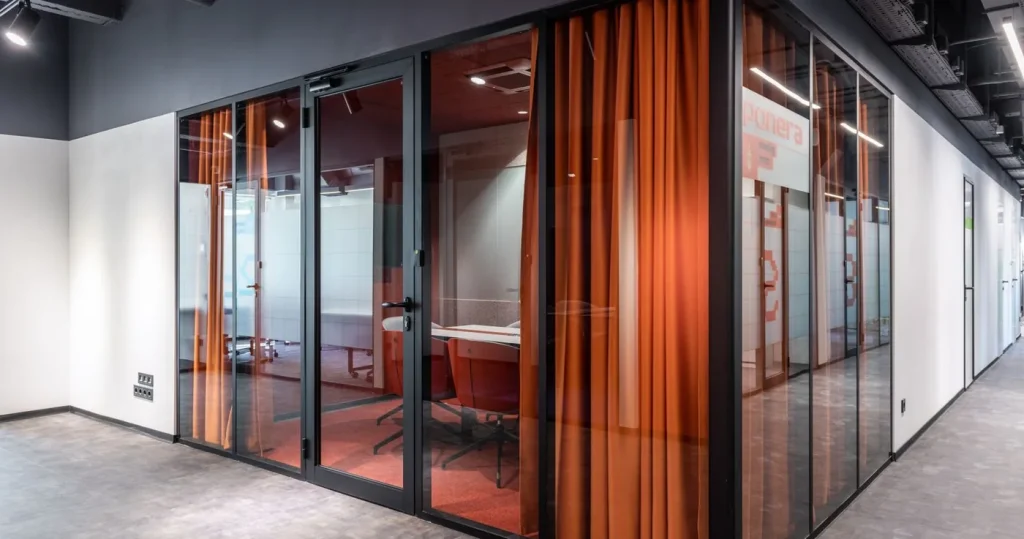
The best office partition ideas divide space without killing the light or the budget — and in Singapore that usually means mixing glass for openness, drywall for private rooms, and modular panels for flexibility. The four main types are glass, drywall, modular systems and cubicles, and each has a clear job: glass keeps the floor bright and collaborative, drywall gives quiet meeting rooms, modular walls let you reconfigure as the team changes, and cubicles give cheap personal space. This guide runs through the partition types, their costs in Singapore, and practical ideas to zone an office without losing daylight.
The four office partition types
Almost every office partition idea is built from one of four types. Knowing what each does best is how you divide a floor sensibly rather than boxing it in.
- Glass partitions — slim-framed transparent (or frosted) panels that split space while letting light and sightlines flow. The go-to for a bright, open, modern office.
- Drywall partitions — solid gypsum walls for full visual and acoustic privacy. Best for meeting rooms, manager offices and quiet zones.
- Modular systems — lightweight panels (fabric, wood or metal) that clip together and can be moved — “office Legos” for teams that keep changing.
- Cubicles — fabric-covered desk dividers that give each person a bit of personal space at the lowest cost.
What office partitions cost in Singapore
| Type | Best for | Indicative cost |
|---|---|---|
| Cubicles | Cheap personal space at desks | Lowest |
| Drywall | Private, quiet rooms | ~S$400–S$800 per 10 sq ft run |
| Modular panels | Flexible, reconfigurable zones | ~S$150–S$300 per sqm |
| Glass | Bright, open, modern look | ~S$100–S$250 per sqm (more for acoustic) |
Cubicles are usually the most affordable because they balance privacy and cost. Glass and modular systems can also be economical depending on the design and how much you reconfigure over time. As a rule, the more privacy and soundproofing you need, the more you spend — and the more openness you want, the more glass earns its place.
Idea 1: Glass-front meeting rooms
A glass-fronted meeting room is the signature modern-office look for a reason: it gives a quiet, enclosed room without darkening the floor around it. Use acoustic glass or a double-glazed unit if confidential conversations happen inside, and add a frosted band at eye level for a little privacy. It keeps the office feeling open while still giving teams somewhere to focus.
Idea 2: Drywall where privacy is non-negotiable
Not everything should be glass. Manager offices, HR rooms, phone booths and server or store rooms want solid drywall partitions for real privacy and quiet — a double-layer acoustic drywall blocks far more sound than glass. A smart layout puts these solid rooms along the core or a windowless wall, keeping the daylight edges for open, glass-divided work areas.
Idea 3: Modular panels for teams that change
If your headcount and team shapes shift often, modular partitions are the answer. Light fabric, wood or metal panels clip together and can be moved in an afternoon, so the floor plan flexes with the business instead of needing a rebuild. They also add colour, texture and some acoustic softening — useful for taming echo in an open-plan space.
Idea 4: Zone without walls at all
Some of the best office partition ideas barely use partitions. Low panels, planters, shelving units, and changes in lighting or flooring can define a breakout area, a quiet corner or a meeting nook without building a single wall — keeping sightlines and daylight fully open. Pair these soft zones with a few solid rooms for focus, and you get a floor that feels open but still works for calls and heads-down time.
How to divide an office without losing light
The most common mistake is over-partitioning until the floor feels like a maze of dark corridors. A few principles keep it bright and usable: keep glass or open zoning along the window edges so daylight reaches deep into the floor; cluster solid, private rooms toward the core; use frosted or fluted glass where you want light plus a little privacy; and match the partition to the room’s real need — quiet rooms get drywall, collaborative ones get glass or modular. Plan the layout around light and how teams actually work, and the partitions follow naturally.
Frequently asked questions
What are the main types of office partitions?
Four: glass (bright and open), drywall (private and quiet), modular panels (flexible and movable), and cubicles (cheap personal space). Most offices mix them — glass along the windows, drywall for private rooms, modular where the team changes.
How much do office partitions cost in Singapore?
Cubicles are cheapest; a 10 sq ft drywall run is roughly S$400–S$800; modular panels about S$150–S$300 per sqm; and glass around S$100–S$250 per sqm, more for acoustic glass. Cost rises with privacy and soundproofing.
Which office partition is best for privacy?
Drywall — especially double-layer acoustic drywall — gives the best visual and sound privacy, ideal for meeting rooms and manager offices. Acoustic glass is an option when you need privacy but also want to keep light.
How do I divide an office without making it dark?
Keep glass or open zoning along the window edges, cluster solid rooms toward the core, and use frosted glass for light-plus-privacy. Low panels, planters and shelving can zone space without blocking daylight at all.
Are modular office partitions worth it?
For teams that reorganise often, yes. Modular panels move in hours rather than needing demolition, flex with headcount, and add colour and some sound absorption — well suited to fast-changing or growing offices.
What is the cheapest office partition?
Fabric-covered cubicles are usually the most affordable, giving each person personal space at low cost. Basic drywall is also economical for creating a few enclosed rooms on a budget.
Planning an office fit-out or reconfiguration?
Glass, drywall, modular or a mix — the right partition plan divides your space for focus and collaboration without losing daylight or overspending. At Roen we plan and build office partitions around how your team actually works. See what complete partition walls in Singapore look like, or talk to us for a layout plan.
Prices are indicative Singapore ranges as of July 2026 and vary with materials, glass build-up, framing and layout. Get a measured quote for exact pricing.