
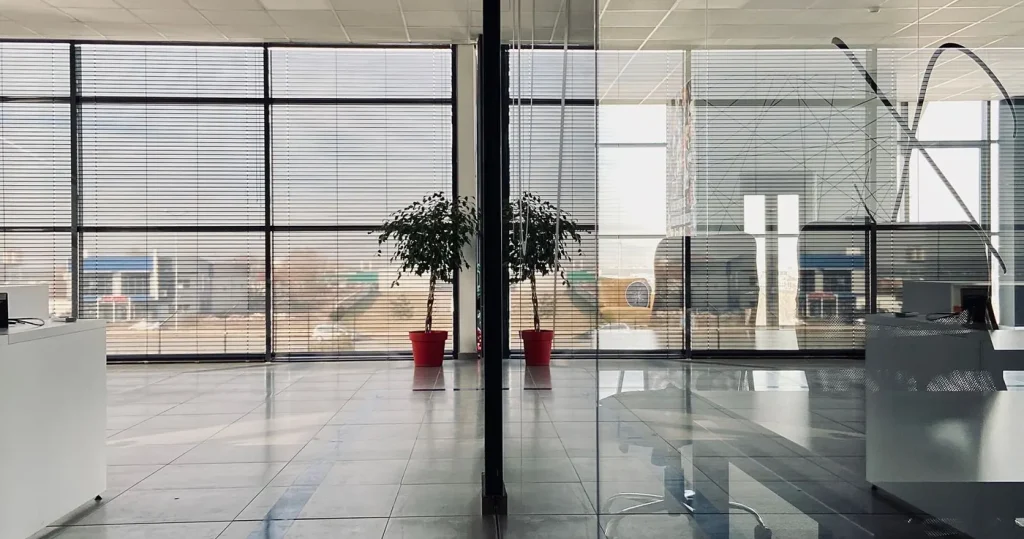
Choose a glass partition when you want light, openness and a modern look; choose a drywall partition when you want privacy, soundproofing and the lowest cost. That is the heart of the glass vs drywall decision. Drywall blocks far more noise and hides what is behind it for less money; glass keeps a space bright, feels larger, and can be moved or reconfigured later. Many of the best spaces use both. This guide compares glass vs drywall partition walls on cost, soundproofing, light and looks, so you can pick the right partition design for your home or office in Singapore.
The core trade-off
A partition wall divides a space, but glass and drywall do it in opposite ways. Drywall is a solid, opaque wall — gypsum board on a frame — that gives complete visual and acoustic privacy. Glass is a transparent panel in a slim frame that divides the space without closing it off, so light and sightlines flow through. Neither is “better”; they suit different goals. The right partition design starts with one question: do you want this space separated, or just defined?
Cost: drywall wins upfront
Drywall is the more budget-friendly option. Across Singapore, partition walls run roughly S$10 to S$60 per square foot depending on material, with drywall at the lower end and glass at the upper. Glass partitions typically cost around S$100 to S$250 per square metre, and double-glazed acoustic glass runs about S$180 to S$260 per square foot. So for a tight budget, drywall is usually the cheaper build. Glass costs more upfront, but can claw some of it back by cutting lighting needs and — for modular systems — being reusable if you reconfigure later.
Soundproofing: drywall wins clearly
If quiet matters, drywall is the stronger choice. A double-layer acoustic gypsum partition with insulation in the cavity reaches around 45–55 STC, versus about 35–40 for a single-layer wall — enough for genuinely private rooms. Standard glass, by contrast, offers limited sound isolation on its own; double-glazed or acoustic glass improves it significantly but at a higher cost, and rarely matches a well-built acoustic drywall. For meeting rooms, bedrooms, home offices or anywhere confidential, drywall (or acoustic glass if you must have light) is the safer pick. A solid-core door helps too, since the door is usually the weakest link for noise.
Light and openness: glass wins
This is where glass shines. A glass partition lets natural light flow through the whole space, reducing the need for artificial lighting and making even a small room feel larger and brighter. In an office it encourages openness and a sense of connection; at home it divides a study or bedroom without turning it into a dark box. Drywall, by definition, blocks light and sightlines — great for privacy, less so for a space that already feels tight or dim. If keeping a room airy is the priority, glass is hard to beat.
Glass vs drywall at a glance
| Glass partition | Drywall partition | |
|---|---|---|
| Cost | Higher | Lower |
| Soundproofing | Limited (better if acoustic glass) | Strong (up to 45–55 STC) |
| Light | Passes through | Blocks |
| Privacy | Low (unless frosted) | Full |
| Feel | Open, spacious | Enclosed, private |
| Reconfigurable | Yes (modular systems) | Fixed |
Which partition wall design should you choose?
- Choose drywall for bedrooms, private offices, meeting rooms, and anywhere you need quiet, privacy or a tight budget.
- Choose glass for spaces that should stay bright and open — a home study, a display area, a collaborative office zone — and where you may want to reconfigure later.
- Choose frosted or fluted glass when you want light and some privacy without going fully solid.
The hybrid approach most spaces actually use
The best partition designs rarely pick just one. A common Singapore approach — at home and in offices — is a hybrid: drywall where privacy and quiet are non-negotiable (the bedroom wall, the meeting room), and glass where light and openness matter (the study divider, the office front). You can also combine them in a single wall — a solid drywall base with a glazed upper section keeps privacy at seated height while letting light over the top. Deciding room by room, rather than picking one material for everything, is what gives a space both quiet and light. For the noisy, private corners, lean drywall; for the bright, shared ones, lean glass.
Frequently asked questions
Is glass or drywall partition better?
Neither is universally better. Drywall wins on cost, soundproofing and privacy; glass wins on light, openness and reconfigurability. Choose drywall for private, quiet rooms and glass for bright, open spaces — or combine both.
Which is cheaper, glass or drywall?
Drywall is cheaper upfront. Partition walls run roughly S$10–S$60 per square foot, with drywall at the low end and glass at the high end. Glass can offset some cost through better light and, for modular systems, reuse.
Does a glass partition block sound?
Only a little on its own. Standard glass offers limited sound isolation; double-glazed or acoustic glass improves it significantly but costs more and rarely matches a double-layer acoustic drywall (45–55 STC).
Can I use glass and drywall together?
Yes — this hybrid approach is common and often ideal. Use drywall where you need privacy and quiet, and glass where you want light and openness. A single wall can even mix a solid base with a glazed upper section.
Can partition walls be moved later?
Modular glass and some panel systems can be relocated or reconfigured, which suits changing spaces. Standard drywall is a fixed build — removing it means demolition and making good, so plan its placement carefully.
Which partition is best for an HDB flat?
It depends on the goal. Drywall suits creating a private, quiet room; glass or frosted glass suits dividing a space while keeping it bright. Many flats use a hybrid — solid where privacy matters, glass where light does.
Not sure which partition suits your space?
Glass, drywall or a hybrid — the right partition design depends on how you use the space, how much quiet you need and your budget. At Roen we plan partitions that balance light, privacy and cost, and build them cleanly to suit your home or office. See what complete partition walls in Singapore look like, or talk to us for a quick plan.
Prices and acoustic figures (STC) are indicative Singapore ranges as of July 2026 and vary with materials, glass build-up, framing and installation. Get a measured quote for exact pricing.