
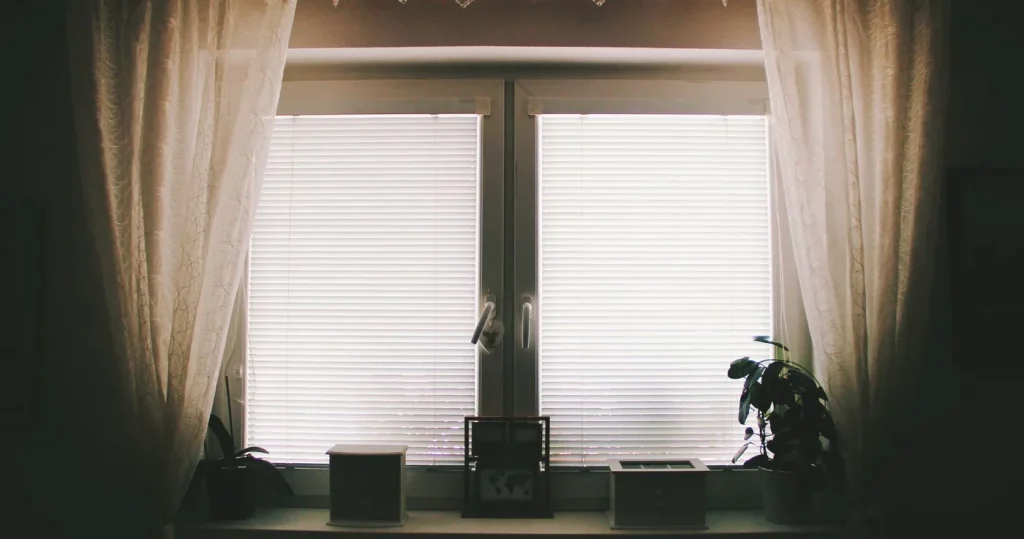
Motorised curtains win on wide, floor-to-ceiling openings (an HDB balcony sliding door, a condo glass wall), because one track motor moves the whole span and the fabric stacks back out of the way. Motorised blinds win on a window with a sill and a recess, a bay, a kitchen or a balcony, because the blind sits inside the frame, one motor per blind, nothing to stack. That is the short answer to motorised blinds vs motorised curtains, and most Singapore flats end up with both on one app. What retail comparisons skip is the wiring: a curtain track is one mains motor near one socket, three blinds on one window are three motors, and a hardwired feed at the window head is Licensed Electrical Worker (LEW) work with HDB conditions attached.
Motorised blinds vs motorised curtains: decide by window, not by flat
Ask three things of each opening: its width, whether it has a sill and a recess or runs to the floor, and the job (blackout, glare, privacy). Width and recess decide the hardware; the job decides the fabric. A curtain needs wall either side to stack into, which a sliding door has and a casement beside a wardrobe does not. A blind needs a flat head and a frame to drop inside, which a recessed casement has and a frameless glass wall does not.
How each one moves: one track motor vs one tube motor per blind
A motorised curtain is your curtain on a motorised track. The motor sits at one end of the track and drives a belt that pulls the carriers across; one motor moves a 3 m run, and a dual track carries sheer and blackout as two motors. The retrofit route is a battery driver clipped onto the existing track: Aqara’s Curtain Driver E1 is rated at up to a year between charges and a 12 kg load (aqara.com, read 1 October 2026). On a Roen install the track and motor are sized to the window at the site check, as part of the smart curtain Singapore service this comparison supports.
A motorised blind works the other way round. The motor is a tube motor inside the roller itself (or a headrail drive on a Venetian or zebra blind), so the blind looks like a manual one with the chain gone. The consequence is one motor per blind: three panes with three blinds is three motors, three power sources and three devices in the app. An existing roller can take a chain driver instead (Aqara’s Roller Shade Driver E1, rated at about two months per charge for a 1.8 m blind moved once a day; aqara.com, read 1 October 2026).
Which suits which window? A decision table for Singapore homes
This is the motorised blinds vs motorised curtains call for the five openings we see most. “Hardwired” means a new 13 A point or fused spur at the window head, installed by a LEW; “rechargeable” means a lithium motor topped up by USB a few times a year.
| Window | Our pick | Motors | Power | App control |
|---|---|---|---|---|
| HDB living room: sliding door to balcony, 2.4 to 3 m, floor to ceiling | Dual curtain track (sheer plus blackout) | 2 track motors in the pelmet | Hardwired behind the pelmet at renovation; retrofit driver in a finished flat | “Day” and “Movie” scenes |
| HDB bedroom: 3-panel casement with sill, 1.2 to 1.5 m | Blackout roller or zebra inside the recess; one wide blind if the frame allows | 1 to 3 tube motors | Rechargeable in a finished room; hardwired only at renovation | One group; 7 am schedule |
| Condo floor-to-ceiling glass, 3 to 6 m, no recess | Curtain track for the span, sunscreen roller behind the sheer on the sunny side | 1 track motor plus 1 tube motor per roller | Hardwired at renovation, feeds hidden in the pelmet | Sun trigger drops the rollers, curtains stay open |
| Open HDB balcony (DBSS and flats handed over after 1 July 2007) | Blind only, porous and fully retractable; a curtain is not practical outdoors | 1 tube motor per bay | Rechargeable; a new outdoor point is LEW work | Retract on a rain or wind trigger |
| Bay or corner window with a seat | Blinds, one per pane; a curtain needs a bent track and loses the seat | 2 to 4 tube motors | Rechargeable, or one hardwired feed along the head at renovation | One group; Venetian adds tilt |
Curtains go where the opening is wide and floor to ceiling; blinds go where there is a sill, a recess, water, grease or a balcony. Motor count is where the money and wiring go: one living room track plus six blinds is seven motors, which is why the power column matters more than the brand. A condo balcony is a by-laws matter; ask the MCST first.
Motorised blinds Singapore: roller, zebra and Venetian, and where each fits
Three blind types cover almost every window. A roller blind is one sheet on a tube: blackout fabric for a bedroom, sunscreen (a woven solar fabric) for a west-facing window where you want the view without the glare. A zebra blind alternates sheer and solid bands, so a few centimetres of travel takes it from open-weave to private, handy facing the next block. A Venetian blind tilts as well as lifts, and in aluminium it suits a sink or hob. Roen fits roller, Venetian and zebra motorised blinds on the same app and scenes as the motorised curtain tracks it installs.
Motorised roller blinds in HDB flats: recess fit or face fit
Measure the recess first. A casement with a sill usually has the depth for a roller inside the frame; where it is shallow or the handles get in the way, the blind mounts above and drops in front, which also leaks less light at the sides. One wide blind across three panes is one motor and one battery; three narrow blinds are three of each.
Battery vs hardwired blind motor: what the power source decides
This decision separates a two-hour retrofit from a renovation job. Makers sell both; Somfy’s Singapore range lists cabled Sonesse motors alongside WireFree lithium-ion motors with a built-in rechargeable battery (somfy.com.sg, read 1 October 2026).
- Rechargeable motors go into a finished flat without touching the wall; the trade is charging each motor by USB at an interval set by blind size and use (two months to a year in Aqara’s figures above).
- Hardwired motors are never charged, run quieter under load and suit a heavy or wide blind, but they need a point at the window head. EMA lists “addition, extension or replacement of electrical power points, such as socket-outlets” among the work that must be carried out or supervised by a Licensed Electrical Worker (EMA, Engaging Licensed Electrical Workers, read 1 October 2026); what that job involves is in how to add a power point in an HDB flat.
- Curtain tracks are simpler. One track motor plugs into one socket near the pelmet, so a hardwired track rarely needs new wiring; the blinds, several of them, high on the wall, do.
HDB rules: inside the flat, on the balcony and at the window head
Inside the flat, HDB’s renovation guidelines for window works list “Installation of bamboo chicks/ venetian blinds/ curtain rail internally” as work that needs no permit, conditions “Not applicable” (HDB, Renovation Guidelines for Window Works, read 1 October 2026).
The HDB balcony blind rule, word for word
For an open balcony “where permanent enclosure is not allowed e.g. for balcony of DBSS flats and flats handed over after 1 Jul 2007”, the same HDB table says no permit is needed, subject to these conditions:
“Installation must allow for natural ventilation within the balcony at all times, even when the screens/ blinds are fully drawn and closed. The blinds have to be able to be drawn open or retracted fully. The material of the blinds must be porous and permeable to allow natural lighting and ventilation to flow through. Glass, PVC or any material which will completely block off sun, light, rain and wind is not allowed. The entire system must be within the unit’s boundary and the existing safety barrier/ railing is not allowed to be tampered with.”
That rules out a blackout or PVC blind and rules in a sunscreen or mesh roller that retracts fully; a curtain cannot meet the test, so the balcony is a blind on a rechargeable tube motor, because there is rarely an outdoor socket.
At the window head: the conditions on a hardwired feed
A new 13 A point is in HDB’s table of electrical works that need no permit, on conditions: “No embedding of wiring (housed in metal/ high impact PVC conduit) in RC slab, beam, column, wall, in wall plaster or other finishes”, the SPSL Form CS/5H submitted for testing, and the number of points “subject to the limitation of the existing main switch rating” (HDB, Renovation Guidelines for Electrical Works, read 1 October 2026). So the feed to a blind motor runs in conduit, trunking or above a false ceiling, never chased into the RC lintel.
Smart blinds vs smart curtains: app control, hubs and Matter
A blind with a radio remote is motorised; it is smart when a hub or app can move it on a schedule, a sensor or a scene. Both use the same four routes:
- RF remote only (Somfy RTS and most entry tube motors): reliable, no app, no schedules without the brand’s bridge.
- Wi-Fi motor on a brand app (Tuya and Smart Life kits): no hub, but every motor sits on the 2.4 GHz network and the automations live in the cloud.
- Zigbee motor through a hub (Aqara, SwitchBot, Zemismart): the motors talk to a local hub that runs scenes inside the flat and keeps working when the broadband drops; our preferred route.
- Matter. Matter 1.5, released by the Connectivity Standards Alliance on 20 November 2025, “introduces a revamped and unified approach to closures, covering a broad range of devices such as window shades, drapes, awnings” with “precise position reporting” (CSA press release, read 1 October 2026). That is what lets a morning scene open the sheer to 40 per cent rather than just “open”.
Whatever the route, put blinds and curtains on the same hub as the lights and aircon, so one “Away” tap moves everything and there is one party to call when a scene misfires. Choosing the hub is in how to set up a smart home in Singapore. On a west-facing window the scene that pays is the 1 pm one: sunscreen roller down in the living room, blackout closed in the bedroom before the sun arrives, not after.
What drives the cost, without a Roen price
There is no Roen figure here (we quote after measuring), but the market ranges are public: Fixfirst puts motorised blinds at “between SGD $300 to $1,500 per window” and Blinds Guru at S$500 to S$1,200 per motorised roller (both read 1 October 2026; market ranges, not Roen’s price). The spread comes from motor count, hardwired or rechargeable, fabric, and RF-only or on a hub. Curtain-side figures are in our motorised curtains cost guide, and the whole-flat view is in how much a smart home costs in Singapore.
Frequently asked questions
Motorised blinds vs motorised curtains: which is better?
Neither everywhere. Curtains are better on wide, floor-to-ceiling openings such as a balcony sliding door, where one track motor moves the span. Blinds are better in a recessed window, a bay, a kitchen or a balcony, one motor per blind.
Do I have to choose one for the whole flat?
No. Decide per window: typically a curtain track in the living room and master bedroom, blinds in the other bedrooms, kitchen and balcony, all on one hub so they behave as one system.
Battery or hardwired motor for an existing HDB flat?
Rechargeable for a finished flat, because a hardwired blind needs a new point at the window head, which is LEW work and must run in conduit or trunking, not embedded in the RC wall. Hardwire at renovation, or for a heavy blind.
Can I put motorised blinds on an HDB balcony?
Yes, without a permit, on an open balcony of a DBSS flat or a flat handed over after 1 July 2007, provided the blind is porous, retracts fully, allows ventilation even when closed, stays within the unit’s boundary and leaves the railing alone (HDB window works guidelines). Blackout, glass and PVC blinds are not allowed.
Do motorised blinds and curtains work with Google Home, Apple Home or Alexa?
Yes, when the motor is on a hub or app those platforms recognise: Zigbee motors on an Aqara or similar hub, Wi-Fi motors on Tuya or Smart Life, and Matter-certified motors. RF-only motors need the brand’s bridge.
Blinds where the window wants a blind, curtains where it wants a curtain, one app for both
Roen measures every window at a free site check, says which suits a track and which a blind, adds any point at the window head through a licensed electrical worker, and puts every motor on one hub with your lights and aircon.